· Updated
Case study: we ran our own AI readiness check on proxa.uk and went from 29 to 69
proxa.uk isn't an online shop, yet our own AI readiness check scored it 29 out of 100. We fixed what it found in one evening (product pages with structured data, a product sitemap and a product feed) and scored 69. The before and after, what we changed, and why a real shop has even more to gain.
In short: proxa.uk isn’t an online shop. We sell three subscriptions, not a catalogue of products. Even so, when we ran our own free check on it on 16 October 2026, it scored 29 out of 100: to an AI assistant, our site was almost empty. The same evening we made the fixes we recommend to stores, and the same check scored 69.
If a site with three products needed this much work to be readable by AI, an online shop with hundreds or thousands of products has far more at stake, and far more to gain. Here’s exactly what changed.
Before: 29 out of 100
The basics were fine: every AI assistant and AI search crawler was allowed in, the site is on HTTPS and answers quickly. But the things AI assistants rely on to recommend a product weren’t there:
- No product pages. Monitor, Clean and Insights were only described on the homepage and the pricing section, so there was nothing an assistant could read as a product.
- No product structured data. No schema.org
Product, so no machine-readable name, price, currency or availability. - No product sitemap and no product feed. Nothing to tell a crawler where the products are.
Remember, this is a software company’s website, built by people who check stores for AI readiness for a living, and it still scored 29. Plenty of shops are in the same position: a site that looks fine to people, and almost empty to an AI assistant.
What we changed
- A page per product at
/products/monitor,/products/cleanand/products/insights: what it does, a screenshot, prices for every catalogue size and billing period, and a buy button. - Full product structured data on each page (JSON-LD): name, description, image, brand, SKU, and an offer per size with price, currency and availability. Software has no barcode, so the SKU is the identifier.
- A product sitemap (
/sitemap-products.xml), listed in the sitemap index, so crawlers find the product pages directly. - A product feed in Google Merchant format (
/feeds/products.xml), linked from every page with<link rel="alternate">.
None of this needed a redesign. If you sell online, your platform probably already makes most of it: the work is usually checking it’s switched on, complete and reachable.
After: 69 out of 100
| Category | Before | After |
|---|---|---|
| Structured data | 0/25 | 21/25 |
| Catalogue completeness | 0/15 | 12/15 |
| Variant data | 5/10 | 8/10 |
| Feeds and sitemaps | 4/10 | 8/10 |
| AI crawler access | 12/15 | 12/15 |
| Basics | 8/10 | 8/10 |
| Protocol readiness | 0/15 | 0/15 |
| Score | 29 | 69 |
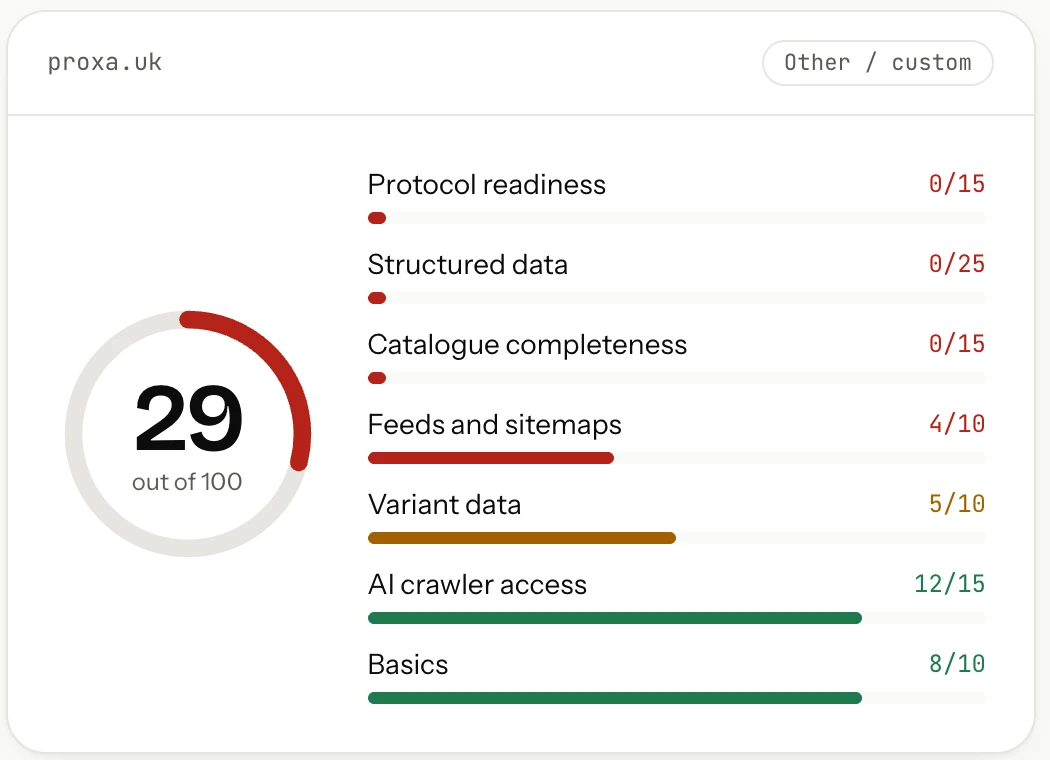
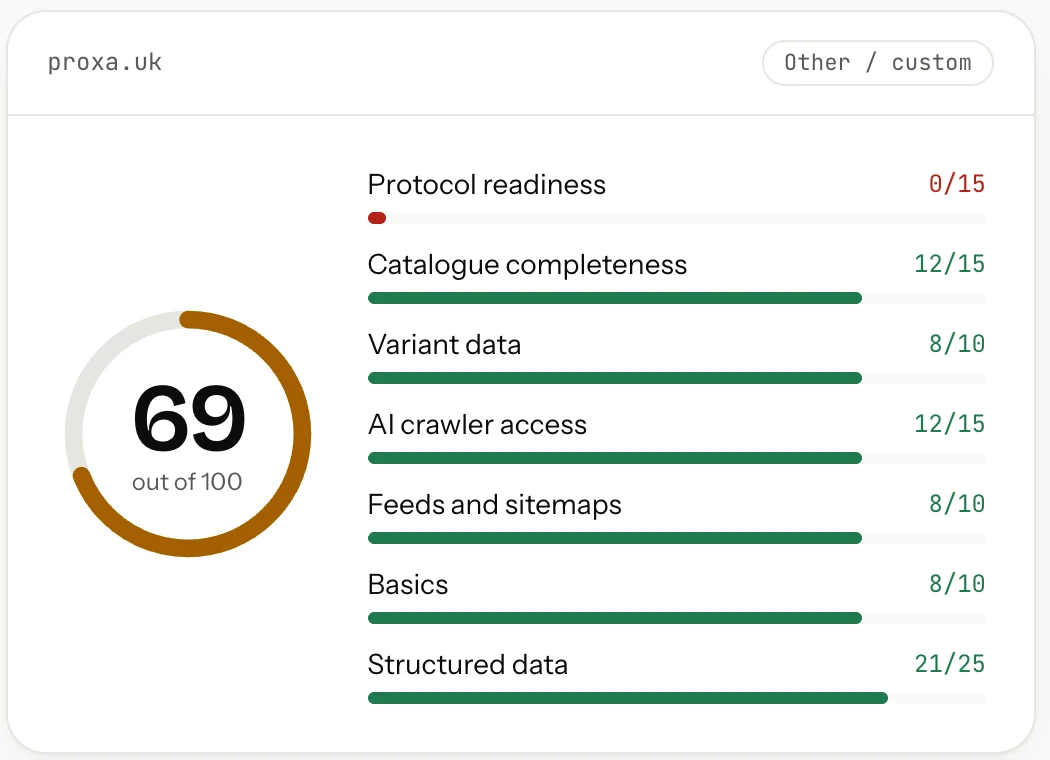
Every category that depends on product data jumped, and the only score still at zero is protocol readiness.
What’s left
Protocol readiness (0/15). The agent commerce protocols (UCP, ACP and MCP) let AI agents discover a store’s catalogue and buy from it directly. That’s what Proxa Connect will do for stores, and it’s coming soon; when it’s ready, we’ll run it on our own site first and update this page.
What this means for your store
A shop has more to gain than we did. We have three product pages; a shop has one for every product, and each one is a chance for an AI assistant to recommend you or to skip you. When the data on a product page is missing, the problem repeats across the whole catalogue; when you fix it in the product page template, the fix reaches every product at once.
And it’s usually quicker for a shop. We had to create our product data from scratch. A WooCommerce, Magento or Shopify store already holds prices, stock, images and descriptions; the work is mostly making sure the theme publishes them in a form AI assistants can read, and that nothing blocks them.
- Most of the score comes from product data, not clever tricks. Structured data, catalogue completeness, variants, sitemaps and feeds are 60 of the 100 points.
- It’s quick to measure. The check takes about 20 seconds and lists the fixes in order of points.
- Fixes break quietly. A theme update or a new security setting can undo all of this without anything looking different, which is why Proxa Monitor re-checks every day.
Run the free check on your store and see where you’d start.
How we measured: both scores come from Proxa’s free agent-readiness check, the same code anyone gets at proxa.uk/audit, crawling the live site from outside: before at 21:05 UTC and after at 21:12 UTC on 16 October 2026, with the changes deployed in between.